


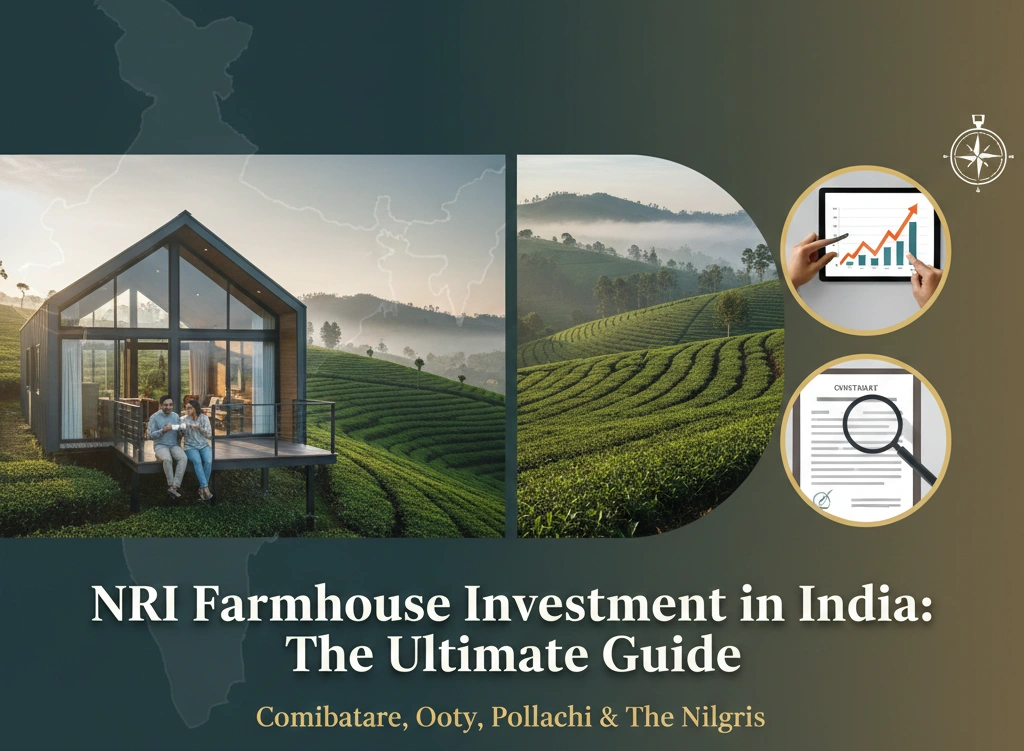
Investing in a Legacy: The NRI Guide to Farmhouse Ownership in South India
For the Global Indian, a home is rarely just a piece of real estate. It is a bridge to one’s roots, a sanctuary of peace, and a legacy to be passed down through generations. As the Indian economy continues its robust growth, NRI farmhouse investment in India has emerged as a premier choice for those seeking high-yield assets that offer more than just financial returns.
Whether you are based in Dubai, London, Singapore, or New York, the allure of the Western Ghats—with its mist-covered peaks and lush coconut groves—is undeniable. In this guide, we explore why Coimbatore, Ooty, Pollachi, Coonoor, and Kotagiri are the most sought-after hubs for those looking to invest in India and live with lushness, peace, and love.
Table of Contents
ToggleThe Benefits of NRI Farmhouse Investment in India
Coimbatore has long been known as the “Manchester of South India,” but for the savvy investor, its true value lies in its outskirts. The foothills of the Western Ghats provide a microclimate that is unparalleled in the plains. When searching for the best place for farmhouse in Coimbatore, areas like Anaikatti and Madampatti stand out for their pristine air quality and sustainable water sources.
At Life In Home, we specialize in identifying land that offers both tranquility and connectivity. For an NRI, proximity to the Coimbatore International Airport and world-class healthcare facilities makes this region a practical yet soulful investment. Unlike urban apartments, a farmhouse here grows in value as “wellness real estate” becomes a global priority.
A Legacy Property for Global Indians: More Than Just ROI
Owning a legacy property for global Indians is about creating a permanent footprint in the motherland. Many of our clients are NRIs and OCIs who want their children to experience the sound of nature, the taste of organic produce, and the warmth of a community that feels like home. A farmhouse in Pollachi or a cottage in the Nilgiris isn’t just a vacation spot; it is a generational asset.
From an investment perspective, the appreciation of land in the Nilgiris (Ooty, Coonoor, and Kotagiri) has consistently outpaced traditional equity markets. Because land is finite in these ecologically sensitive zones, owning a piece of “The Scotland of the East” ensures that your NRI farmhouse investment in India remains a rare and valuable commodity.
Sustainable Living: Eco-friendly Construction in the Nilgiris
Building on a slope or in a high-altitude zone requires specialized expertise. Eco-friendly construction in the Nilgiris is not just a trend; it is a necessity for preserving the landslide-prone terrain of Ooty and Coonoor. Our team at Life In Home utilizes local materials and advanced soil testing techniques to ensure your home is both beautiful and structurally sound.
We believe that “lushness” shouldn’t come at the cost of the environment. By incorporating rainwater harvesting, solar energy, and indigenous landscaping, we create homes that breathe. This commitment to sustainability is why we are considered the leading bespoke builders for those making an NRI farmhouse investment in India.
Navigating the Legal Landscape for NRIs and OCIs
One of the biggest hurdles for global Indians is the “Trust Gap” regarding land laws. While NRIs can easily purchase residential and commercial property, agricultural land involves specific FEMA (Foreign Exchange Management Act) regulations. This is where our legal team, led by Advocate Prabu, steps in.
We provide 100% legal due diligence, ensuring that the land is free of encumbrances and has clear titles. Our 0% commission model on land sourcing means you get the best market price directly from the owner, with a transparent consulting fee for our expertise. We act as your boots on the ground, so you can manage your NRI farmhouse investment in India with total peace of mind.
Conclusion: Your Sanctuary Awaits
The dream of owning a farmhouse in India is about finding a balance between modern luxury and raw nature. Whether it is a plantation bungalow in Coonoor or a lakeside retreat in Pollachi, your investment represents a commitment to your future wellbeing. If you are looking for the best place for farmhouse in Coimbatore or a legacy property for global Indians, the Western Ghats is calling.
Let Life In Home help you build a space filled with love. NRI farmhouse investment in India has never been more accessible or more rewarding. Are you ready to reconnect with the soil?
Visit our About Us page to meet the team or explore our Soil Testing Guide to learn about our construction standards.
Frequently Asked Questions for NRI Farmhouse Buyers
1. Can an NRI or OCI buy agricultural land or farmhouses in India?
Under FEMA regulations, NRIs and OCIs generally cannot buy agricultural land, plantation property, or farmhouses directly. However, they can inherit such properties or seek special permission. Many NRIs opt to invest in “converted land” or residential plots designated for farmhouse development, which is where Life In Home’s legal expertise becomes essential.
2. Why is Coimbatore considered the best place for farmhouse in Coimbatore for NRIs?
Coimbatore offers a unique blend of “Tier-2” city convenience (International Airport, IT hubs, and world-class hospitals) and proximity to the pristine Western Ghats. For NRIs, it provides a secure environment with high appreciation potential compared to saturated metropolitan markets.
3. What is the average cost of an NRI farmhouse investment in India?
In the Coimbatore and Nilgiris region, turnkey farmhouse construction typically starts at ₹1800/sqft. Land prices vary by location, with Pollachi and Anaikatti being highly cost-effective, while Ooty and Coonoor command a premium due to limited land availability.
4. How does Life In Home ensure a legacy property for global Indians is secure?
We solve the “Trust Gap” by providing 100% legal due diligence through our in-house legal team. We manage everything from land sourcing with 0% commission to turnkey construction, acting as your local partner to prevent encroachment and ensure quality.
5. What makes eco-friendly construction in the Nilgiris different?
Building in the Nilgiris requires adhering to strict Hill Area Conservation Authority (HACA) norms. Our eco-friendly construction in the Nilgiris focuses on slope stability, natural drainage, and using sustainable materials that blend with the mountain ecosystem.

Read full story
📞 Call for Site Visit
- 5 Best Farmhouse Exterior Styles for Your Coimbatore Home - April 1, 2026
- 5 Best Farmhouse Staircase Styles for Luxury Homes - April 1, 2026
- 5 Best Farmhouse Welcome Area Styling Ideas for Luxury Entries - April 1, 2026
Leave a Reply
You must logged in to post a comment.